Showing posts with label Atlus USA. Show all posts

Thursday, September 4, 2008

SMT- NOCTURNE (HARD MODE): Demonology 102

I have talked a lot already about what demons in the game do and how they are arranged in relationship to one another but there are a few other points to cover. I wouldn't normally get so deep into mechanics if I wasn't convinced at this point that they are integral to the game's deeper messages. How these cogs and gears turn in the Vortex World (this is the clinical term) is a statement unto themselves. I actually have some trouble thinking of other games where these connections are so clear. I mean, did anyone think the 'materia' system in FF7 really meant anything to the game other than, "We at Square have a cool new word to use when talking about magic!" FF7 is a great game, but like many others the systems involved aren't part of the story. It gets worse when characters in the game's cut scenes use skills or spells in ways impossible to do in the actual player-controlled part of the game. That's not breaking the fourth wall, but a fifth wall or something.

Now returning to the subject, the trait that is most important to demons is clearly their skills. Skills are the building blocks of the combat system and ignoring their role will most likely land you in swirly angel land very quickly. Each demon starts with two or three skills when you first get them, and as they level and get stronger they learn new skills. These skills are predetermined by the demons type and are granted when they become the appropriate level for that particular skill. To get an idea of how important these skills are, think of the lowly Foul Will-o-Wisp that I spoke of in an earlier post. He had a skill called zan, which is a magic attack with good damage and low mp consumption. It was a bit better than his normal physical attack so it saw lots of use. Then upon reaching a certain level he learned mazan, which is the same skill except it hits every enemy on the opposing side. Between mazan and his high agility score, he could go first in nearly every combat and damage the whole opposing team before things even started for them. This made encounters with serious baddies far more survivable, and allowed me to explore parts of the map I had only rushed though before. With the skill mazan the Will-o-Wisp went from regular party member to the center of the offense.

Sometimes you capture a demon out there and you may not be so in love with their current skills, but the skills you see coming up for them are so great you put up with having a dud on the front line so this demon can level up and get the skill you're waiting for. On the status screen you can actually see the next skill that they will learn, though many times you wont know what it does exactly having never actually seen it in the wild. Nonetheless it's hard to pass on something called "Dark Might". That is another skill where it's inclusion in a party changes the landscape so dramatically it can reverse the outcome of boss battles. It is a little unfortunate that the demons in certain ways become backgrounds for the skills they possess, but this is probably to make sure that these demons keep changing and morphing into new forms.

How this happens is a two pronged facet of the game and one of my favs overall. In most major areas of the game is a central location with shops, warp points, healers and a place called the Cathedral of Shadows. A nice place, if you like swirling mist, giant concrete pillars and freaky ZZ-Top looking dudes dressed in purple robes. Upon entering this interesting locale for the first time, the 'Minister' informs you that he is there to aid you specifically. Now he is clearly there to aid the player, none of the shops in any of the other games ever made seem to get other customers than the player, but at least he acknowledges this fact.

The Cathedral is where you can take two demons that you have in your party and turn them into another demon of greater strength (most of the time anyway). The two demons chosen to be "Fused" are put at the top of the pillars where they disintegrate and combine into the new demon in a dramatic cut scene. It is possible from what I hear to have accidents occur during the fusing process where what you get is something totally unexpected, but I haven't seen that yet. Also you can sacrifice a third demon at the same time during regular game events and that will make the resulting demon even stronger. This will add levels and new skills to the resulting demon, but you have to be careful when doing this as their skill sets can change dramatically reflecting the skills of the sacrifice more often than not. I figure this is for when you have two powerful demons with skills you don't want, just throw in another demon with skills you like and you get a powerful and useful demon out of it. It's an expensive option however as the only demons that make good sacrifices are the ones that you have leveled many times through battle.

This fusing system is set alongside a more common idea of evolution. Certain demons have multiple forms and leveling them to the point where they have learned all the skills that are possible for them to learn will allow them to evolve into a higher form. This is something players should concentrate on because these evolved demons are powerful and usually come with two or more really great skills right out of the box. They also tend to jump up many levels, even more than you would normally be allowed to control, so there is a serious bonus there. The one thing here that is a bit confounding is that when they evolve they tend to remain in a similar shape but their clan affiliation can change. One would think that they would stay within the family as it is essentially the same demon. For example the demon Beast Inugami evolves into Avatar Makami. They look very similar but yet are of different clans. It's the same demon too clearly as it possesses many of the same skills right where you left them on the non-evolved form. However this does help to counteract the high turnover that seems to plague the front line of the average party.

That leads me to why I think things are set up in this fashion. As this game starts to unfold I am starting to see the over arching concept. Demons are at the center of everything, a seemingly easy spackle to the game being both friend and foe, but they are also a metaphor. The story puts you into what is essentially a half-baked world, and the idea is that you may or may not have the power somehow to decide what comes out of it. The game calls it "Reason". Whatever your Reason is this is what becomes of the Vortex World. It looks like everyone who survived the destruction has a chance at what comes next, and the one with the strongest Reason is the one who wins.

The demons are the living embodiment of that violent change. Not only are they constantly learning and evolving, they become building blocks for other demons as easily as walking into a shop. You decide who continues to exist and who is ground up for parts. There are allusions to machinery and fate and the inevitability of pain and destruction, all of it pointing to the fact that the new world is a giant crucible. And for all it's power, vastness and variety, it too in the end is only to be ground up into parts for some yet larger construction. As above, so below.

Friday, August 22, 2008

SMT- NOCTURNE (HARD MODE): A Fiendish Labyrinth

To put it bluntly, this may have been the wrong game to challenge on the hard mode. The mania that has me gunning for harder and harder play from videogames has probably finally gotten the best of me here. Not that I'm giving up mind you, this is a very good game. The path to take when putting your team together is always clear, but sometimes you need more strength and luck than you are going to have at that point. The complaints that I had in the past have since been mollified by the great gameplay in SMT: Nocturne. And we all know that things like art and story tend to take a backseat to the meat of the game once you've got your hands in it. The art is still sort of an eyesore, but the story has taken a few nice turns that I think are interesting. On the whole, the demon training/combining part of the game is satisfying too. Look for more details in Demonology 102, coming up next week.

Now on the subject of difficulty, I have been cursed twice by my own hand. Once when the game asked me, "Will you play the kiddy wuss version of the game? [NORMAL] Or are you a bad enough dude to rescue the president? [HARD]" (I'm paraphrasing here) I mean... really. What could I have done? It's not like me to take that kind of guff from a videogame. So I had to choose [HARD], but perhaps they should have called it [DESERT ISLAND MODE]. Secondly I need to discuss a game called Shin Megami Tensei III: Nocturne Maniax.

This is the director's cut of the original game released in Japan, and was the game that was brought to the states and translated by Atlus for release as SMT: Nocturne. Maniax added a number of new elements, including a place called the Labyrinth of Amala. The labyrinth is a place reminiscent of your old Ultima Underworld games (beat em), or the more recent Etrian Odyssey (beat it). It is a tough as nails dungeon with traps and pitfalls and many other kinds of carefully engineered doom. You gain access to this place after defeating a jaunty skull-headed fellow named "The Matador" and talking to an old man in a wheelchair and his hot goth nurse type... person.

After the battle you whisked to this alternate world with walls the color of blood and creepy music. Once there you hear from the Old Man that he once had eleven candelabrums (candelabras?), one for each level of the Labyrinth. And he wants me to get them back from the fiends who stole them from him. I said yes, naturally. After all when presented with an epic quest what else would one do? What I didn't understand at the time was that I was already on an epic quest, and this was totally optional. I could have said no, and have never heard from either of them again, or had to fight ten fiends. The real problem is that each of these fiends is placed in irritatingly close proximity to the regular bosses, who are pretty tough, and are about twice as strong. There hasn't been a boss battle I haven't had to spend time on preparing for yet. Having two of these battles back to back without any kind of story progression is really annoying. Had I known about the structure of the optional content would I have changed my answer? Probably not. Massive dungeons are a reason I buy games to start with.

So as I defeat each fiend and get his candelabrum, I can travel deeper into the labyrinth. With all the preparation (read: grinding) needed to overcome the bosses it makes for the perfect playground for xp farming. The place has it's own rules and story as well, which makes it more interesting. It is also very big, big in the sense that every level of the labyrinth has multiple floors of it's own. One trip down a ladder can put you up against demons you have no chance of beating, that's of course if you aren't lucky enough to fall into a pit trap that takes you down lower than that even. There certain death is dealt to you by totally unfamiliar demons who will reflect your own attacks back at you. No kidding, it is the classic "you don't belong here yet" kind of beatdown you might remember from the old days.

I haven't played a game where the possibility of death was so great since my days of Nethack obsession. It is only a certain part of the game so the comparison is not perfect, but without the greater amounts XP gleaned from this place I'd be wandering around the overworld for ages trying to get the same things done. Despite all the roadblocks I've pridefully put up for myself, I am still quite looking forward to the tasks at hand. A sure sign I am dealing with a winner here.

Friday, August 15, 2008

SMT- NOCTURNE (HARD MODE): Catch em all?

I don't think I can really get into much further discussion of Nocturne without going over the primary attractions of the game, the demons. From what I can tell so far, there isn't a battle you fight in the game that isn't against a demon of some kind. One of the many hooks here is that the very same demons can become your allies without much trouble. In fact, you aren't getting very far at all without getting as many demons on your side as possible, as soon as possible. And this is only allowed because the main character himself becomes a demon very close to the start of the story. Having trouble keeping all these demons straight? I don't blame you.

My guess is that there are probably more than a hundred of these colorful characters out there to fight and recruit. Each demon has an individual name and a clan name. They are constructed like so where if the demon's name is "Jirae Kodama" "Jirae" is the clan name, and "Kodama" is the individual species name. They also seem to fall along various physical themes, and these themes do not stick too close the clans where they are dominant. For example, "Jirae Kodama" and "Jirae Sudama" are alike in color, size and skills, but "Jirae Hua Po" is also of Jirae clan, yet looks far more like a member of the "Fairy" clan, "Fairy Pixie". Furthermore Hua Po and Pixie are seen banding together against the player in random battles in many places at the start of the game. Hua Po and Kodama are also found alongside one another, but less often for some reason.

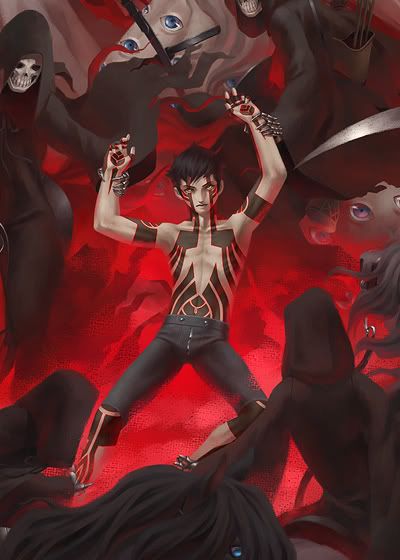
To give you an idea of what you might see for demons in the new Toyko, you have "Wilder" clan, which is a clan of beastlike demons. The "Divine" clan is a clan of angelic demons (believe it or not). The "Foul" clan is full of slimes and ghosts. A personal favorite, the "Megami" clan is a phalanx of female demons based on various goddesses. The "Fiend" clan is the one the player belongs to, having consumed a special type of demon to gain it's powers (more on this later). Having only seen a small portion of the total group, around 15% by the reckoning of the Demonic Compendium (think pokedex), I can't really say if these patterns are consistent throughout the demonic world or if I will be surprised again by what I find.

Getting these demons to do what you want can be an interesting process and not too difficult. I have already been warned that there are demons that won't choose to go with me of their own free will but I haven't encountered any of them yet. What you want to do is first find the demon that you want in a random battle, then isolate them, killing everyone else in the opposing party. If there are other demons around either they will block the attempt. Once that is accomplished you can use the "talk" command or have one of your demons use the "seduce" skill. The only difference between them seems to be that "talk" is automatically part of the main character's battle menu. Then the demon will usually start demanding items, money or to drain your 'power' (HP). These requests are never simple, you nearly always have to give them two or three things before you get the final stage of negotiation. The demon you are trying to get to join the team asks you a question. Usually it's something like, "Are humans meant to suffer, or is it just their own stupidity that causes suffering?" I kid you not, this is a very philosophical bunch. You must answer in the positive or negative, and based on that the demon can join you or just take all your stuff and leave, even if you answer correctly. Hell, they can break off the negotiation at any point they want. I've seen this occur with weaker demons more often though. A stronger demon will most like get every last thing out of you before making a decision.

I'm pretty certain at this point that there is a series of secret variables that keep track of your relationships with the various demons, or at least the various demon clans. At the start of the game I recruited a weak demon, probably the weakest one, named "Foul Will-o-Wisp". Foul clan demons are hard to communicate with, you mostly you have to wait for them to halt combat to talk to you. He requested a healing item, I gave it to him and he joined up. He was a kind of floating ball of white smoke with a suffering grimace floating in it. As the game wore on, he naturally gained levels and sometimes upon leveling up he would ask to talk to me. At these points he started giving me gifts, healing items mostly. What happened next was even more amusing.

Every time I would encounter another Will-o-Wisp, they would stop fighting to come over and beg for items. Apparently it had gotten around that I was a friend to the Foul clan! It had gotten so bad that when I decided that I didn't want to avoid combat by placating the demon with money or items, the Will-o-Wisp would just leave combat dejected, robbing me of his precious experience. Annoying for sure, but endearing too somehow. My Will-o-Wisp was essential part of my early game because of his force attacks which could hit every demon in the opposing group at the same time. Now all demons can exhibit these behaviors in varying amounts, but I never again came across another demon as loyal or emotive at the "Foul Will-o-Wisp". I eventually had to break him down for parts at the Cathedral of Shadows (more on this in another post) to make a stronger demon and I have to admit there was a little regret in the decision.

There is another demon out there with even stranger behavior than this. The title of Strangest Demon easily goes to "Yoma Isora". The Isora is a big aquatic manta ray sort of deal that lives in the sewers of the Great Underpass of Ginza. I noticed first that they're negotiation questions were always very windy and often didn't have clear answers, so getting them was always a coin flip. Then after recruiting a few one rushed up to me and begged for his life, offering advice for the kindness. I relented and he gave me a tip on using demon skills that I already knew and was off. After that Isora would break combat to run up to me and ask me their strange questions, all without provocation or a "talk" command. Sometimes I would get items, sometimes not. They would always leave afterward. Once an Isora started talking to me without even a question being asked first. Just rambling about the universe for two or three lines, and then gone like the rest.

Perhaps the Isora are the scholar-poets of the demon world. They seem friendly in their own way, if only a little too much so. During a routine battle I watched an Isora run up of one of the other demons in my party, not even to me! (this has never happened again) Once there and situated in front of "Beast Inugami" he ranted, "I see a RIVER! A glorious shining RIVER! I give my life to you!" And then immediately joined the party without my permission. Not what you'd expect from your garden variety Seaking, eh?

Thursday, August 7, 2008

SMT- NOCTURNE (HARD MODE): Eatin' demons, castin' spells

I have been eagerly awaiting this game since about the time I went searching on ebay and saw the exorbitant prices for used copies. They were usually about $40 - $60. I checked reviews and it scored very favorably, and I was very interested in the dark demon summoning setting as well. I had made a decision early on in my PS2 years when I decided that I would obtain the Shadow Hearts games as they came out and wait until later to catch up on the SMT stuff. This has saved me quite a bit of money until now since the game count on the SMT/Persona side is considerably higher, and the games more sought after in general. Don't get me wrong, the SH series is A-class stuff. Even the first game has lots of great moments.

Well, now I am playing Nocturne and my initial impressions are... mixed. I was puffing up this game a bit on the hype probably, but I don't usually let it get to me. There are two things worth mentioning first that I won't usually hold against a game. One, the main character is on of those silent/yes/no types. This is an old-school thing and I understand why it works. This allows the player to identify with the protagonist, allowing the player's internal commentary to take the forefront in the play experience. I'm not a major fan of it but you can't get on a role playing game for using respected tools of the genre. I mean, am I going to rag on hit points next? Ahhhh, no.

Secondly there are no voices in the game. Of course this is another old-school thing, but not so much for the same reasons. Older games were on carts or simply didn't have the budgets for voice tracks. Now this game was released in an era when at least partial voice tracks were pretty common, but not totally so. I will have to watch this and see if this was an artistic choice or not. Neither of these really have degraded the experience for me, but I just wanted to cover them before going on.

One thing that is really bothering me is that the main character is an emotionless freak. I mean not a peep during combat or a strongly worded (yes/no) response during conversations. The story thrusts this high school age boy into a post-apocalyptic world riddled with demons bent on his destruction, and of course this is after he's undergone an instantaneous demonic puberty that has left him radically changed. Even Dragon Warrior would give us a "!!!" at climatic points. Is this an extension of the silent hero idea, or another artistic choice? Perhaps he really is nonplussed by all of these things. Perhaps he's a chosen one who was born here in a past life or something. Like Paul Atredies, "He will know our ways..." Gawd, I am really making excuses here. My point is that this could be the case in which his near-psychotic detachment would make sense, sorta. But, could he look any more bored??? Ok we're past that now.

The other issue I am having is with the art. This was probably the first cel-shaded game for the SMT people so you can say they were getting used to it, but the real-world environments look really washed out and bland. When you get to the more strange alternate-realms the game puts you into things are far more visceral and convey mood well but they have been rare so far. Could they be trying to make a contrast here? I'm not sure. On the character end of things the art style makes them look stiff and manikin-like. Emotion again is hard to find and in general the designs are not so interesting to look at. I am only five hours into the game now, so these things will probably change a bit as the events take their toll on people. The demons on the other hand have some really great designs, even if the themes chosen thusfar are not the most original.

My guess is that the real star of SMT: Nocturne is supposed to be the setting, which is fantastic. The heart of the main story right now is a mystery about what the heck happened to the world, so at the start the protagonist is fumbling around trying to learn about how this new world works and this allows the largest amount of exposition on the setting. This new world is a nightmarish mirror of the real one, and also a very brown mirror, but it seems to have existed long before the arrival of the main character. There are factions, rules and common complaints coming from it's numerous denizens. So did we travel in time as well as in space when the world changed? Or was the real world the mirror of this one?

Combat in Nocturne (I'm playing on hard mode btw) is a fast turn based system that allows for just enough depth to keep it fun and challenging. It is possible to end up in random battles that can overwhelm you, so saving is a virtue, but so long as you don't make any obvious blunders even these battles can usually be weathered. Demons, their strange behaviors and their powers are obviously as the center of the system but I will save that part for later when I have seen more. The music is very good, if a little quiet at every moment other than battle.

It may be possible that this is a game elevated to it's acclaimed heights on the fact that the setting is so totally unique. Most of the things done here in the systems and design have been done all or in part before. It's a mish mash of good ideas, and I like the way it works. Right now I am just waiting for the moment where I care about what is happening to these people and hoping that the real gold in Nocturne ends up coming out in the story. At least I'm pretty sure I won't be disappointed.

Monday, August 4, 2008

ODIN SPHERE: Armageddon

I have beaten this game and seen both endings and I can say that it will be in my PS2 top-five for all time. An amazingly good game with an equally great story and the best 2d artwork of ANY game on the system hands down. Also, Odin Sphere is unique amongst my favorites for getting it's spot the list for it's story foremost, then graphics and then gameplay. More novel-like than any game I have played, it is not only completely voice acted, but those voices never detract from the presentation instead enhancing the gameplay whenever characters speak. Atlus USA should be lauded for it's job on the localization. All of these elements make Odin Sphere a real triumph. Now how did the game end, you're wondering?

I won't be giving anything away when I tell people that the end of Odin Sphere is the end of the world. You can make guesses at that after looking at the cover of the game, the game's titular king, Odin, is a character from Norse mythology where the event of Ragnarok (the Norse end of all creation) figures heavily. This world-ending has a different name, but the myth is borrowed from in parts along with a few others from other cultures to make the game's overall theme. Where the endgame gets it's texture and context is in a series of texts known generally as the prophecies. These can be accessed any time for reading in the 'prophecy' menu, and are won from npcs in story events mostly. The old manuscripts tell about the end of the world from a number of different perspectives, but the major ideas do not change. The world will be visited by five calamities and in the end the land will fall away into the void and the sky eaten by the Lord of Serpents. During the Armageddon Mode, the entire experience changes. The beauty that the world once possessed is shattered and just about everyone perishes in the calamities.

It is easy to look at the graphical style and the characters, a fairy princess for example, and think that Odin Sphere is for youngsters but it is relevant on the adult-level far more often than it is not. I think the art style and the lush nature of the environments are designed to be placed next to the blasted devastation of the armageddon mode as a contrast. Kamitani (the director) wanted us to mourn for Erion, I think. The npcs lament, cry and beg for release from the doom of their senseless deaths. The forests burn, and mountains are brought low and the great cities razed without exception. We are to be given the explicit message that nothing survives this devastation. There is a 'good' ending obviously but as always these things are relative.

That brings me to the way the endings are handled. Each of the five calamities must be defeated by one of the five main characters. Not only that, but for the 'good' ending each calamity needs to be fought by a particular character, and the choices are not obvious even when you use the prophecies as a guide. There is one curve ball that pretty much guarantees that you will see the bad ending before the good, though this is probably by design however as nothing in the game was done without a great amount of thought.

Now before and after each of these five battles there are cut scenes, and for each of the five characters there are good and bad cut scenes depending on who you choose and therefore which track you are on. I should say that some of the best story in the whole game is given over in 'bad' endings for the various characters, so you will probably need at least three trips through armageddon mode to see it all. It's certainly worth the effort.

I really can't go any further without giving too much away, but this kind of match-the-character approach to ending the game allows for an amazingly multi-layered story to close out this epic. You get many viewpoints to the end days of Erion and you even have a chance to end things on a lighter note if you are careful about it. If you folllow the path the texts lead you along, there is one last book to read where the fate of the world is decided. As a videogame, Odin Sphere will most likely be referred to by designers time and time again for the way in handles narrative and plot. Right now there isn't a game that does it better. As I mentioned in a previous post, George Kamitani is going to be a big Kojima-like deal before too long. Count on it.

Saturday, August 2, 2008

Hard Mode, hard to pass up?

I must be some kind of masochist. I'm about to start playing Shin Megami Tensei: Nocturne, having recently finished Odin Sphere, and I am already stuck. At the start of a new game the game asks you if you want to play with normal difficulty or on hard difficulty. I can't decide which I want.

Now I like a challenge, but I don't like being stymied or having to grind for levels. Now you may say, "But dude, that is what 'hard' means in RPGs!". This is not always true. In the original Valkyrie Profile, the hard mode allowed access to events and optional dungeons that the regular mode did not. Also the increase monster strength allowed for the tactical nature of the combat system to be expressed, making every action in combat more important. The thing I really can't stand in games is mindless combat. My tastes run toward the tactical anyway, so having myriad skills and spells that never see the light of day because your regular attacks can take care of all the challenges for you is unforgivable. In a game with all the layered systems and optional dongles of SMT Nocture, my fear of having this happen was even more acute.

I am about an hour into the main game now and the weakness of the enemies is giving me the heebie-jeebies, so I need to learn what the hard mode actually adds to the game. Now I read everywhere on the interwubs that this game is very hard at certain points, but I see no mention of the hard mode. So I dig deeper, one player says that there is no extra content in hard mode. No extra events, characters or dungeons. Not what I wanted to hear. Next tidbit I get is that in hard mode there are basic mathematical increases to monster strength, and probability based attacks like insta-kills and status effects are far more common. Insta-kills are insta-annoying, and yet...

To actually beat the game on hard mode, wouldn't that be even more awesome? Wouldn't I have to pimp the systems to their utmost to prevail? Wouldn't I get the greatest appreciation for the game design and textures in the game rules by challenging myself? Wouldn't the spectre of death make every random encounter all the more interesting?? The spectre of DEAAAAATHHHHHHH! (He's right over there... don't look!!)

Ya anyway, I can already see myself restarting on hard mode. This is happening tonight. *sigh* Am I nuts? The only guarantee is that I will spend more time playing this game one way or another, and I have a huge pile of games to play after this one. Is beating SMT: Nocturne on hard mode even all that important? Nothing but the math is changing here apparently, but the very fact that few if any of the goobs on gamefaqs, UGO or IGN have claimed this feat for themselves makes me want to try it all the more. There is one other thing I get out of this, however. And that is that no matter how I grind, min/max, combo or match traits to situations, I will not feel as though I am cheating myself out of any of the challenge. Is this the puritan work-ethic at work in my demon summoning/training/breeding/eating video game? Yeah probably.

Thursday, July 24, 2008

ODIN SPHERE: Healthy cooking for the coming apocalypse

I am knocking on the end of this game, but I have encountered the dreaded endgame grind that I once thought would be confined to the various Fantasies Final. The occasion of needing to power-up the various characters of Odin Sphere leads me to use a system that I only rarely visited during the normal game. There are two parts to it actually; The Pooka Kitchen and The Pooka Cafe.

I should explain what a pooka is first I guess. A pooka is a little rabbit-person who once used to be an actual human but was effected by the "Curse of the Pooka". The entire nation of Valentine was afflicted with this curse through the machinations of it's mad king. Valentine is not a very nice place to be at the moment, but the Pooka still live there underground. They get involved in various plots to heal their land, mainly trough the Pooka Prince and Velvet, the princess of Valentine. This underground village is where the cafe and kitchen are located and all the characters gain access to this place eventually, but some much later than others.

Now once you have access to the village you can start cooking, and cooking is all about hit points. Each character has two levels instead of one, one level rank for your psypher weapon and another level rank for your hit points. You get experience for your psypher by killing foes and collecting the phozons(little purple firefly like things) that appear when they die. You get experience for your hit points by eating food. There is no other way. You often find various food items in the course of battle, and often seeds from which to grow more food as well. These seeds eat the aforementioned phozons to grow into trees or vines that give fruit. When you eat the food whatever it is you get an immediate healing effect, which fills your current total of HP, but you also get an about of xp that goes towards your HP level. The higher this level the higher your maximum hit points will be.

This is why cooking is so important; the food you cook in the pooka village (kitchen or cafe, they both work the same way) gives WAY more xps than the food you find laying around or grow from seeds. They have complicated recipes as well, which you find in the treasure left behind by enemies. One of the oddities here is that you actually need to bring the food you want to cook to the pookas, instead of just buying it when you get there. Times are lean for the little guys I guess. At any rate, one of my favorite recipes is for Yogurt Stew. Doesn't sound so good, eh? Well remember that what we want is levels, and this particular dish has good xp for not too much trouble. The recepie goes like this, one carroteer, one yogurt, one portion of chicken, and an ariel coin(one of the various coins featured in the game). The important part of this particular recipe is that most of the ingredients can be manufactured without too much trouble.

Yogurt is easy to get from milk, and milk is available from many shopkeepers in the game. The carroteers can be found in the ground in certain places, you just need to know where to look. The chicken comes from eggs. This makes sense, right? Well, in Erion the process for getting the chicken is most curious. First take your egg and place it on the ground, after a bit a little yellow chick will hatch from it without any help from a mother hen. This little chick will wander the level, eating whatever plant seeds it finds. Once three seeds are eaten it will quite magically transform into a big grey hen. It then becomes your job to beat on the poor thing until it once again magically transmogrifies into a chicken bone with meat attached. This parody of agriculture could only be more ridiculous if it actually changed into a bucket of KFC original recipe.

I like to get the components for four of these dishes before I trek to the kitchen. It takes a little time but it's worth it, seeing as four stews will double your max hps if you're anywhere near the 300 mark. I haven't found the need to balloon my max hps in this way until this point, but it is an interesting little system. In a way, if you had the necessary components and access to the village you could shoot way past the intended hit point totals needed for where ever you are in the game. I suppose the investment in time is good deterrent, but there isn't anything really stopping you from grinding previously visited levels and getting fat on HPs.

It should be mentioned that the ingredients for the more complex dishes aren't available in most stories until after the midway point. So those are harder to abuse, but it isn't like phozons where the only way to get them is by slaying enemies. Is it the devs allowing the player to ratchet their own level of difficulty a bit, just some fault-tolerant design? With the heavy twitch-factor involved it might have been a stroke genius to include the kitchen and the cafe, but it is obvious that by the point I am at now I was supposed to have been using them much more.

Monday, July 21, 2008

ODIN SPHERE: Velvet

Velvet is the final character and her tale, "Fate" is the final book in the main story. At this point both NPCs and texts of prophecy have hinted at a story after the current one, but the focus of this post is of course on the chain wielding vixen herself. Tooling about with her is about as different as I think would be possible in the game engine.

Now my assumption earlier that she was a 'stick and run' kind of character was correct, but I only barely scratched the surface there. As a matter of course when Velvet uses her dual-psypher chain against enemies, they do not take any knockback. That is that when you are comboing into an enemy Valkyrie, she's comboing right into you at the same time. Your weapon does less damage than the average, and at the same time will not keep anyone from attacking you up close. It is also very easy for enemy attacks to knock you out of your combo, creating a real offensive lack in comparison to the other characters.


Another layer in the failcake that makes Velvet's combat skills inferior is that her combos in general are longer. This means that it takes more time to get to the most damaging attacks which are invariably at the end of the combo. During this time she is standing stock still, getting attacked from behind or above. She does excel in a few areas though. First thing to remember is that she is a range fighter first, and whenever she can you have to use the range advantage because of the lack of knockback from her chains. The upshot of this is that she is a menace against smaller enemies, including flying enemies. Her special trick is a "homing chain" attack that basically just streaks out beyond the screen and wreaks havok with any number goblins, frogs and various spirits so long as they are in range. At higher psypher levels this is usually a one shot kill.


Secondly her spinning dance-like attacks seem to shield her from whirling swords, arrows and fireballs while she is attacking. The value of this is felt especially against wizards, who's many crimes have already been discussed. Lastly she is a good mover and can get around quickly, using her chain in a tarzan swing across the screen during which she is totally invulnerable to attack for some reason. Using this often is sometimes key to nailing down the bosses because it falls perfectly into the 'run' part of the 'stick and run' strategy. These positives though fun to play with, and while not failing to make fighting with her interesting, don't really make up for her overall lack of punch in most cases. Chalk this one up to your usual increase in difficulty over time of gameplay.

Now there are many good things about Velvet, not the least of which is that she is a bastard princess that dresses like a old-timey burlesque dancer. Always appreciated. Her voice work is easily the best in the game outside of Odin himself. The voice actor in this case really conveys the correct emotion in all instances and enhances the game to the effect of my next point. Velvet's story is the most compelling in my opinion. It is ultimately tragic, (I think they all could be eventually...) but it deals with some real issues and carries the player a little bit beyond the screen in the way the FFVII did.


"Fate" is actually about Velvet and her brother, Ingway. Ingway is a fav of mine despite the fact that he is never actually controllable. He figures in major ways in two of the other four tales so you do get to know him pretty well by the time Velvet is the subject of the game. His story is a bad boy makes good kind of tale, which meshes nicely with Velvet's fight against her prophesied destiny. Being at the end of the main game, Velvet's tale plays a little of the 'clean-up' role in Odin Sphere. So she does spend a little time re-treading some ground already traversed by others, but in return she also ends up learning the most about the game world and seems to have complete dominion over the 'shockers' in the story. Events here go most of the way in explaining why things are the way they are, so story wise she is easily the best character.

Now strictly speaking the end of Velvet's tale is not the end at all. At this I have to admit that I was a little disappointed, after all I am ready to move on to something new. What awaits on the other side of her tale is the Armageddon Mode, which at the moment I do not understand in the slightest so I'm not commenting on it now. I am taking a break from this one for a week or so however. So expect something different next time.

Wednesday, July 16, 2008

ODIN SPHERE: Frigging Wizards

I love this game, but there is one enemy that just makes me completely lose patience. This is the wizard. These little jerks are raised in a dingy city known at Titania, where I have spent some of the most frustrating moments of the entire game. Part of this is due to the fact that wizardly biology allows for a single wizard mother to whelp a litter of between eight and twelve of the beard-stroking abominations in a single breeding.

The other is their annoying propensity to teleport away the very second you hit them. Of course only the 'pointy hat' breed of wizard will perform this particular injustice upon you, the weaker (and far less numerous) 'hoodie' breed of wizard will just stand there and take their beatings like normal enemies, bless their little hearts.

Now all of this is really not even the issue, because this part of the wizard experience is totally manageable, cute even. It is when you add their varied and totally cheap attacks into the mix that you begin to understand true evil. Both species of odinius wizaratus have the following player-enraging powers;

1. throwing fireballs (natch)
2. summoning little eyeball familiars (not too annoying here)
3. creating whirling swords that shoot out at you in various mesmerizing patterns and do serious damage (not my favorite)
4. summoning ice spirts (this one we don't need)
5. summoning fire spirits (also wik)
6. summoning incorporeal as in untouchable yet still quite damaging spirit beasties from the netherworld (WTF?)
7. damaging+poisoning you from half a level away (We need more wizard regulation in America!)
8. AND turning you into a frigging frog.

As you can see any extended battle with two or more of these wretches quickly leads to ten or so other flying beasties chasing you down as you try to dodge whirling swords and fireballs while poisoned. THEN when you finally get to them and they TELEPORT away! What gives? Why do these game developers hate us so? Is it karma? Is there a god?

You might want to wait to ask yourself the last question because these terrible, hateful robe wearing demons can also be bosses. No no, not mid-bosses, the real deal. There are three wizards in the main story; Urzur, Skuldi, and Beldor and they all suck ass. Why sugar coat it? All three need to be fought at different times, though it seems only once each. Beldor appears as the handler of a dragon named Belial at a few times at the start of the game. Of course you don't fight Beldor at that point because anyone confronted with his cheap ass bull so early on would probably quit the game.

I don't want people to get the wrong idea, these little fucks can be beaten. I've done it a bunch of times already. You just need to strike their whirling swords back at them, which stuns them momentarily and keeps them from teleporting away. The problem becomes doing this twenty times against the wizard bosses while fighting all their pets. I am currently stuck on the Beldor boss battle where you have to fight the wizard and the dragon at the same time. This is probably the hardest boss battle in the game, in my defense. All I have to say is... this charade ends tonight, Beldor.

Monday, July 14, 2008

ODIN SPHERE: Oswald

I should first say that I've been playing Odin Sphere for a few months so I'll be starting my posts about this one (and more than a few others) in media res. I'll come up with a list of the titles I'm playing at some future point. As for the experience of playing Odin Sphere to this point I have to say it's been a major blast.

It's as if Final Fight got into a steamy love affair with the movie "Legend". The results are really something. The artwork and story are top notch. The game looks so impressive the name "George Kamitani" (the game's director) will be one you remember. The main tale is told from five perspectives. One for each playable character. I am currently playing through the story for Oswald, the Black Knight. He's the fourth of five, so I am more than halfway done with the game. The three others I have already played, Valkyrie, the Pooka Prince and the Fairy Princess are set up in a similar fashion, with the major differences coming in the attacks and abilities of the characters themselves.

At it's heart the game is a side scrolling brawler so the way you play the Black Knight is very different from the way you played the Pooka Prince. Just try to remember how the combos for Guy and Cody of Final Fight forced different play styles and you'll have the basic idea. Some of the characters have to fight at range, others are straight up brawlers that need to be up close and the Valkyrie and I am assuming Velvet (the final character) are stick-and-run types able to do a little of both.

Now on to Oswald, the Black Knight. He's a guy we have already seen many times in the stories of the other characters. To put it bluntly, he spends the majority of his screen time being a tool, and killing dragons and the like for a variety of dumb reasons. His story is one of a lost soul finding his way through love... Sounds sappy, right? Well out of the entire cast so far, Oswald is the most devil may care of them all. He resorts to killing and intimidation with little regard for the opinions of others. After grinding my teeth through the "Fairy Princess" story this was quite a welcome change. Oswald's job is essentially to be as bad ass as humanly possible. Put more simply, he's the Chuck Norris of the Fairy Kingdom. He fills this role with aplomb, even if he gets a little emo at points.

His combos and moveset are easily the strongest in the game. His weapon, the "Belderiever", is often said to the most powerful weapon ever crafted, and the ease with which it slays the heck out of stuff backs this up. It's really novel that in this instance when you are told that you are the most potent warrior ever, you actually are! In many RPGs, especially western RPGs, the strongest weapon or most powerful arcane knowledge imaginable ends up being just a palette swap of some other weapon or spell with slightly better stats. That of course does not mean that his boss battles are easy, on the contrary some of them are annoyingly difficult, but the rabble that comes in between them is nearly inconsequential. Just think of Swartzenegger in Commando. There's a very similar effect here.

So Oswald is all offense and little defense, but what really gives his part of the game some challenge is a restriction on where you are actually allowed to go. Usually after beating an area of the game map you are allowed to return there and get reagents for potions and exps and all of the good things that come from fighting evil. Not so here.

This brings us to a discussion of the ever elusive Carroteer. Now, a carroteer is just like a carrot, except it is part of a class of various in-game vegetables known as mandagoras and it has some kind of magical property that allows you to turn them into healing potions. This of course makes them the ONLY mandagoras a roughneck like Oswald is going to ever care about. Different areas of the game have these tubers in varying amounts. The ground will yield one or sometimes two different kinds. It is usually customary halfway though a story to take a break from the main road to go back and grind a little in the Carroteer's favorite zone to stock up on healing potions. The trouble is that Oswald, so love stricken at the time, could never imagine doubling back to help make life a little easier for the player. That is that these previously played areas are simply not selectable. Very annoying.

I suppose this makes an offset to the Belderiever's amazing offensive power, but at certain points at the end this restriction makes getting hit by enemies at all a serious problem. Oswald's low defensive qualities combined with no healing makes things harder. Add this to the fact that Oswald's quest for love gets him into a number of boss fights where the air is filled with swarms of weaker enemies, making him a finesse fighter all of the sudden. Switching gears between the normal fights and the boss fights with Oswald is part of the challenge here for sure. It's an interesting design choice, making the situation play the character instead of the other way around.

The very end of Oswald's story is actually the start of the last movement of the Valkyrie's story, where he plays a major role. Of course I've already seen that, so I know how his play really ends, but it's so interesting to see how Oswald went from a deadly enemy at the start of Valkyrie's story to something totally different by the end of his own tale. Here we see how the stories intertwine and feed on one another. This is accomplished with the aid of the extensive "Drama" menu that lays out every cut scene in the game in a linear timeline. As you see them in game they become available for review, or for a complete replay from start to end with touch of one button. This is nothing to sneeze at as in one continuous play the Fairy Princess' story took over 25 mins from beginning to end.